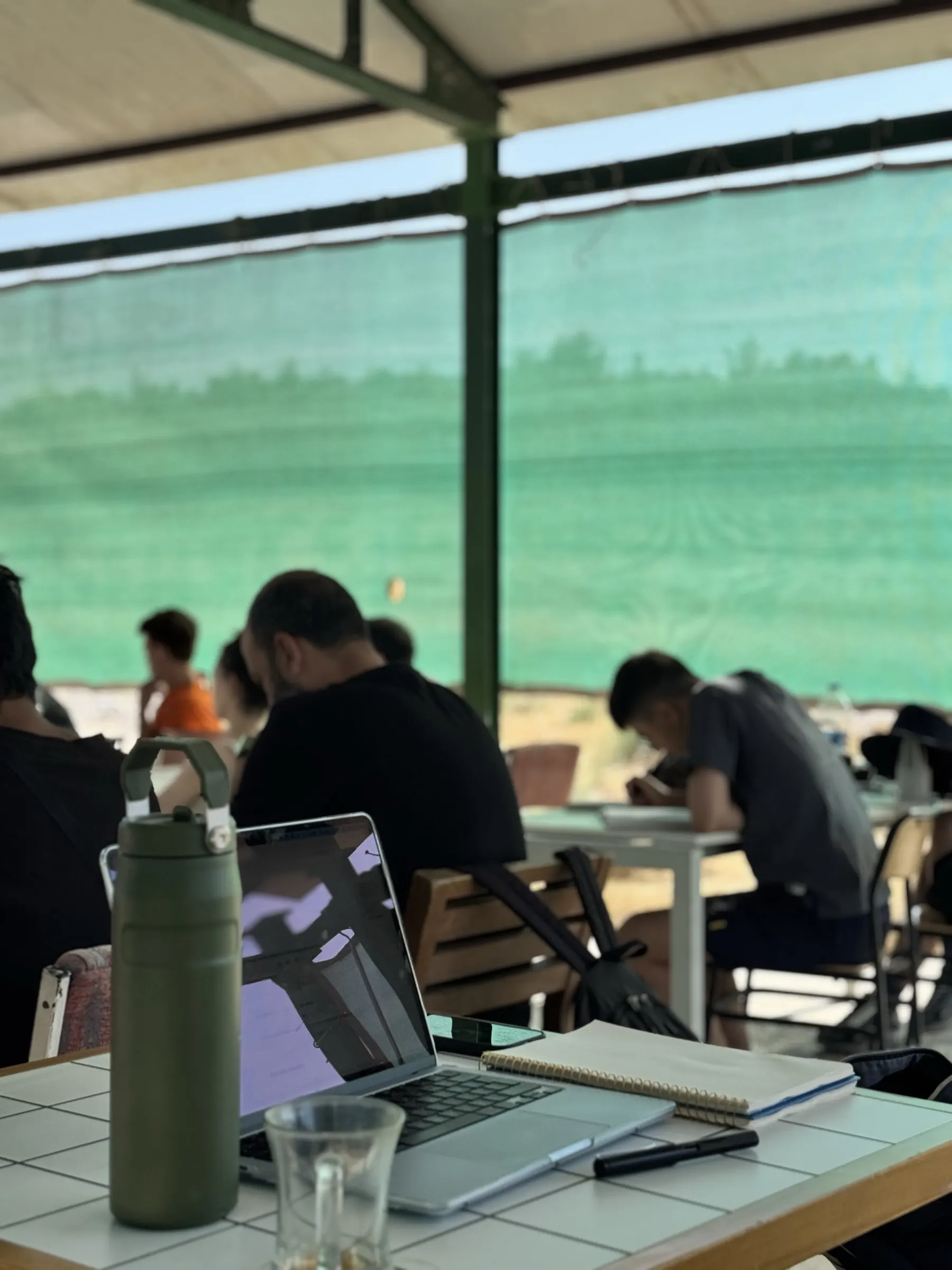
The Bilimler Köyü (Village of Sciences) project took root in 2018 as the shared dream of a few researchers and volunteers. Behind this dream was the desire to contribute to the deepening of scientific thought and academic production in Türkiye; to help philosophical and critical thinking reach wider audiences; and, above all, to create a space where young people could freely nourish their curiosity and take an active part in holistic and collective thinking processes.
Such a goal could not be achieved within the boundaries of university campuses alone. That is why Bilimler Köyü was designed as a camp setting immersed in nature, where shared living spaces are built and shared together and where learning blends with life. The institutional foundation of this vision was laid by the Bilimler Association and the Bilimler Foundation, both established in 2018. The Association and the Foundation began working in coordination to support the project and to take on its organization and coordination.
These efforts soon paid off. In 2019, a 70-decare plot allocated by the Foça Municipality became home to the construction of the village, thanks to the dedicated contributions of volunteers. In a short time, Bilimler Köyü turned from an idea into a tangible place.
Since 2020, Bilimler Köyü has organized weekly programs every summer in the natural sciences, social sciences, philosophy and the humanities, with contributions from many academics and experts. Encouraging interdisciplinary approaches and critical thinking, these programs offer participants not only the chance to gain knowledge but also to create and debate together.
The village is not just a place where lectures and seminars take place; it is also a community space where collective life is experienced. Young volunteers take on the responsibilities that make the social life of the village possible, scientists volunteer to lead lectures and workshops, and participants enrich the spirit of the village by taking an active part in processes of thinking and production. Sustained every summer by the shared labor of hundreds of people, this community keeps growing year after year.
The Bilimler Association and the Bilimler Foundation continue their work to make this community lasting and to pass it on to future generations. The aim is to create stronger conditions in which not only scientific production and debate, but also sharing, collective labor and living together can take root.
Today, innovations emerging at a dizzying pace in information technologies have spread the production and transmission of data and information to every domain of life in such a way that they can no longer be confined to any particular place or center. We are both in a position that presents data concerning certain characteristics of the universe, nature, society, and the human being as a source of specific information through our own life practice, and we possess tools that can access this data and information within seconds and with ever-increasing precision and detail. These tools are developing day by day and will continue to develop; as long as these developments continue, the presuppositions regarding the human being's relationship with knowledge will continue to be questioned.
Yes, the barriers to the circulation of data and information are being rapidly eliminated, and this situation is creating striking changes in our social relations and in human existence.
However, it is still too early to claim that access to information/data guarantees or facilitates the process of attaining knowledge.
Data and information can offer us raw descriptions concerning the "appearance" of certain phenomena or movements in the universe and the relations among them; however, attaining knowledge of these requires more than this. To attain knowledge of a "thing" means to be able to situate it within the whole to which it belongs and thereby to gain an understanding of "what it is, how it came into being, and what it can become," as well as to illuminate the obscure domains concerning the functioning of the whole of which it is a part. In this respect, the endeavor to attain knowledge involves, beyond the task of compiling and organizing findings concerning the surface appearances of what exists, the posing of the right questions aimed at establishing their relation to the whole and the making of appropriate abstractions. And this requires a never-ending process of conceptual and theoretical discussion.
As people who have worked at universities for years, we can say based on our experiences and observations that today, while the human being flounders within the ever-growing and expanding enormous cloud of information, they are moving away from reflecting on the ways and methods of taking the right steps on the path to attaining knowledge.
This great accumulation of data and information expands only in accordance with the needs of those who possess authority and power, and only to the extent and in the direction they determine. Today, under the dominance of a market economy conception that has been liberated from restrictive and regulatory interventions aimed at securing the public good, any effort at "learning" that does not serve the pursuit of accumulation and profit is declared "unnecessary." All over the world, universities are being transformed around a conception in which data, information, and skills that will be useful in the market are displayed and exchanged, while profound, philosophical, and conceptual thinking is regarded as "wasted expense and time"—and in this process, they are losing their soul. This ever-growing void is being filled with all manner of anti-scientific narratives, from conspiracy theories to fake news, from traditional dogmas to "new age" mysticism—narratives that appeal not to people's reason but to their emotions, that provoke not their curiosity and desire for change but their anxieties.
In a world where these tendencies are becoming increasingly dominant, the pursuit of setting out with a sound mind and a correct method toward attaining knowledge, the mental labor devoted to this end, is either being devalued or is being perceived as an antiquated craft of a small minority disconnected from society as a whole.
Yet we are passing through a period in which the effort to attain "knowledge" needs to spread to the entirety of society. In a time when the world and humanity are, at every level, in a "holistic" and structural impasse that threatens their very existence, the answers to the question "what can we do" against this can only emerge from within a mode of thinking capable of establishing the connections between the part (singular problems) and the whole (the general functioning of nature and society)—that is, from within an understanding that pursues "knowledge." Answers that would truly benefit everyone can indeed be found to the question "What can we do together to emerge from the crisis of humanity?"—provided that public spaces and environments can be created that open such a process of thinking and discussion to society. Today, what is sought with a candle beneath the deluge of data and information is the collective discussion of the abstractions, methods, concepts, and theories that will direct these toward the path of attaining "knowledge."
In 2019, the idea of building the Village of Sciences emerged from precisely this search: to make this urgent need visible and, at least to some extent, to close this gap by creating an inspiring example and model—together with a group of researchers, scientists, and volunteers who regard being a "possessor of knowledge" as everyone's right.
If "attaining knowledge" requires establishing the relation of the part to the whole, then it is necessary to move away from the tendency in today's academy and universities to become increasingly confined to a single "discipline"—and indeed, beyond that, to a single "research topic"—and from the tendency to distance and isolate different domains of "knowing" from one another. For this reason, our program was designed to include all research and knowledge domains categorized under headings such as natural sciences, social sciences, and human sciences, without giving priority to any one over another. For the same reason, we have endeavored to encourage each event to be organized, as far as possible, from a perspective that transcends interdisciplinary divisions.
If the process of attaining knowledge requires a collective and egalitarian intellectual discussion, and if this "equalizes" everyone who is part of our village—regardless of their level of "knowledge"—in the commonality of having set out on the path toward knowledge, then we have tried to extend this understanding of fellowship to the entirety of life in the village and to all work processes. We have tried to include everyone staying in the village in all the processes that make life and events possible in our village.
The Village of Sciences emerged as an idea in 2019 and has, since 2022, reached a position where it organizes events with precisely this perspective. In this short period of time, we have seen that in an era when people are bewildered by the speed of data/information flow, it is very important not to reject the possibilities afforded by the developments in tools for accessing data and information, while at the same time never forgetting that the effort to "attain knowledge" is a social process requiring collective labor. As we see that the events we hold leave lasting traces in the thought world, memory, and outlook on life and humanity of our participants, we become ever more committed to this idea.