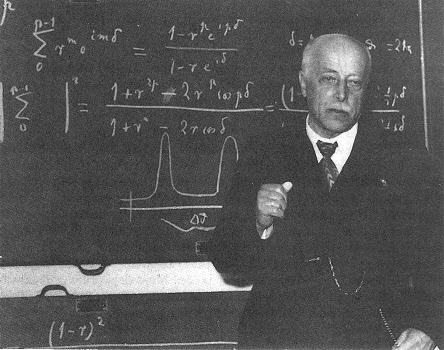
Born in Germany on October 9, 1879, Max von Laue made revolutionary contributions to the field of physics.
In 1914, he was awarded the Nobel Prize in Physics for his discovery of the diffraction of X-rays by crystals. This breakthrough charted a new course for crystallography and played a pivotal role in the development of quantum physics.
During the Nazi era, he displayed immense courage by defending academic freedom against fascism. At a time when many scientists succumbed to the Nazi regime, von Laue refused to take the 'oath of loyalty to the Führer.' He stood firmly against the suppression of science.
He was a close friend of Albert Einstein. Laue's discovery of X-ray diffraction and Einstein’s theory of relativity grew stronger through the mutual inspiration they drew from each other's work. Their friendship was further rooted in their shared commitment to the values of scientific liberty.
Max von Laue passed away on April 24, 1960, following a tragic traffic accident in Berlin. Today, his scientific legacy and moral courage continue to serve as a beacon of inspiration for scientists worldwide. We celebrate his birthday and honor both his contributions to science and his unwavering ethical stance.