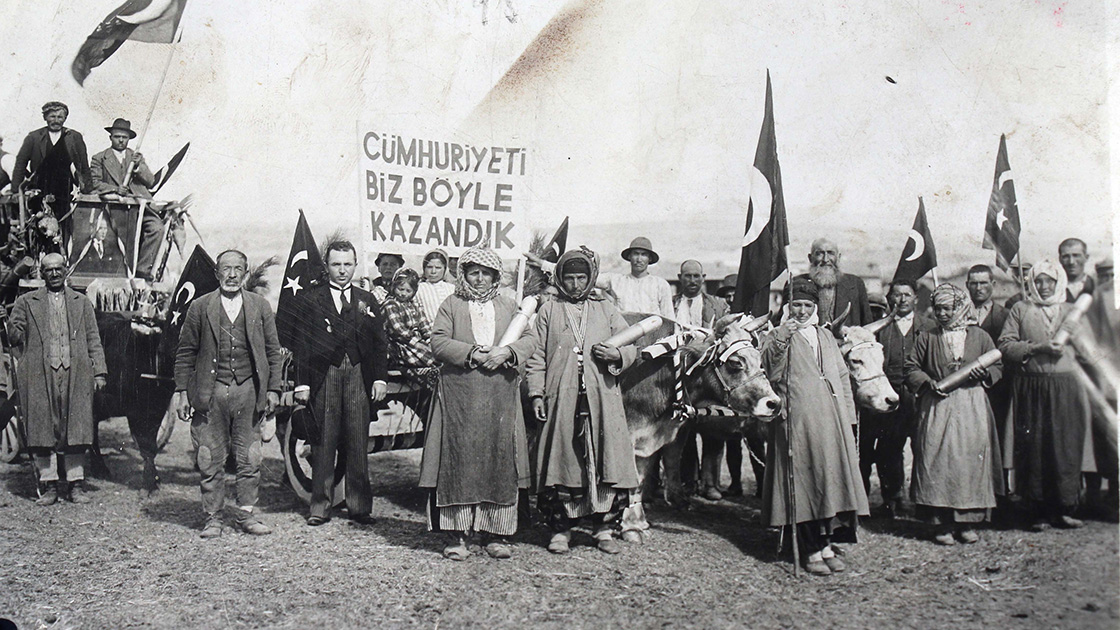
October 29... Today marks the day the Republic was proclaimed—not merely as the name of a new country, but as its very form of governance. Happy Republic Day to us all. It is possible to celebrate this day by confining it to the nostalgia of black-and-white photographs or drowning it in the deafening celebrations of concerts. However, another path exists: attempting to understand and explain it within its historical context, creating the possibilities to carry its essence into the present and the future. In the light of science, we have chosen the latter.
History is not a collection of isolated points. The Republic was not a secret kept until the day before, only to be revealed in a single moment. October 29 cannot be detached from the contradictory, conflicted, and multidimensional course of history. While it is possible to define the Republic as an idea, a political regime, or a form of government, within the flow of life, it is a practice of positioning and organization born out of social and political struggles.
The Republic is the product of a process and a political will that extracted a 'Republican vein' from a Parliament in 1920, where most horizons were limited to Constitutional Monarchism. This will was shaped as the Grand National Assembly organized itself to leave no other organ or authority outside of its own power. It is the product of the same will that in 1922 abolished the Sultanate, terminated the Istanbul Government, and dissolved the Ottoman Empire, declaring: 'We liberated the motherland, and we shall be the ones to sign the peace treaties.'
The abolition of the Sultanate and the linking of Istanbul to Ankara stirred the Assembly. It triggered resignations within the government and alienated the pioneering figures of the War of Independence. Voices began to claim, 'We passed a law called National Sovereignty, not National Sultanate; we can even bring the Sultan back if we wish.' Against this line, the Republic emerged as the product of the will that defended the sovereignty of the people and the decisiveness of the National Assembly.
Through a constitutional amendment, the first article of the 'Treason against the Nation Act' (Hıyanet-i Vataniye) was changed to state that the rights of governance belong solely to the Grand National Assembly—inalienable, indivisible, and non-transferable. Following the decision that the term of the First Parliament had ended, the Second Parliament was established. In July 1923, the Government of the Grand National Assembly signed the Treaty of Lausanne. Throughout all these critical stages, the Republic was the product of the will that rendered the nation's parliament fully authorized.
What occurred on October 29, 1923, was the formal recording and stabilization of the understanding of sovereignty defended by the Republican vein that had emerged victorious through this conflicted process. By amending Articles 10 and 11 of the Constitution, it was decreed that the Parliament would elect the Head of State from among its own members, and this leader would be the President.
This constitutional change, proving that every dimension of sovereignty resided within the TGNA, officially formalized the form of government as a Republic. In short, the Republic is the product of a long, painful, and conflicted process. It could only be proclaimed once the Republican line grew stronger and demonstrated that the Parliament had seized power unconditionally.
Based on the outcomes of the workshop 'Who Doesn’t Love the History of Governance?' conducted last summer with Fatma Eda Çelik, we have outlined a framework to reflect upon the Republic. We will continue to explore the Republic and its foundation at the Village of Sciences with Prof. Fatma Eda Çelik in the coming periods.