Biology and Society
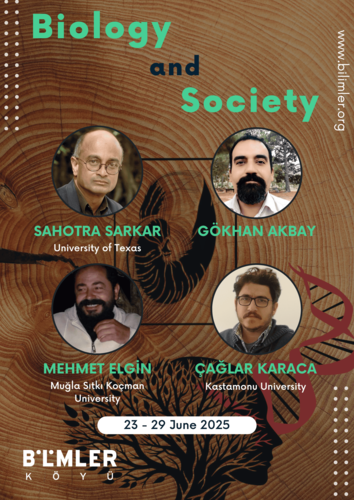
Etkinlik Bilgileri
- Mekân Bilimler Köyü
- Son Kayıt Tarihi 21 Haziran 2025
- Geliş Tarihi 22 Haziran 2025
- Başlangıç Tarihi 23 Haziran 2025
- Bitiş Tarihi 29 Haziran 2025
- Kontenjan 20 kişi
- Kimlere? Herkes
- Etkinlik Ücreti 9.000 TL
Etkinlik Amacı
Who can participate?
Everyone, provided that the participants are able to read and discuss fluently in English.
Scientific areas covered by the activity: History and philosophy of science, Biology, genetics, ecology, philosophy of cognitive science
Day 1: Introduction. Biology and ideology. Hereditarianism and modern genomics: the misuse of genetics for political purposes with historical examples from eugenics, and IQ testing movement.
Day 2: The conceptual underpinnings of behavioral genetics, its shortcomings, and how these shortcomings have carried over into modern behavioral genomics. Ecology and conservation biology.
Day 3: Aristotle, Darwin, and the Modern Synthesis: The nature of the Darwinian revolution from the perspective of Kuhn’s theory of science the concept of incommensurability, whether and when empirical evidence is useful in evaluating which paradigm is better.
The problems which, from Darwin onward, led to the so-called modern synthesis of evolutionary theory. Accepting the most basic claims of a paradigm does not mean that the normal science governed by that paradigm is free from disagreements and lively discussions. Disagreements and discussions about how heredity functions and how natural selection operates. Normal science is not a simple detour or a temporary state on the way to more exciting revolutionary science.
Day 5: Epistemic Anthropocentrism
Philosophical analysis of anthropocentrism as part of an effort to understand the biological origins of cognition. The epistemic dimension of anthropocentrism manifesting as a bias that frames nonhuman cognition through a human lens, disregarding the evolutionary contingency that gives rise to diverse cognitive functions and structures. Cognition as a multidimensional phenomenon emerging across the vast phylogenetic diversity of species through various forms of behavioral individuality. The case of Physarum exemplifies an organizational approach that challenges the homunculus view of cognition.
Day 6: Diachronic Emergence through Shifting Localities of Control
The problem of emergence has long divided philosophers of science. Jaegwon Kim’s influential critique argues that strong emergence is incompatible with the causal closure of the physical world, thereby pushing towards reductionism or epiphenomenalism. However, biological processes such as embryonic development and gene regulation demonstrate diachronic emergence through contextual dynamism. Unlike a fully deterministic system, where the microstate at t1 rigidly determines the macrostate at t2, biological systems exhibit shifting localities, where regulatory nodes dynamically hand off control across changing phases, with coarse-grained transitions between these phases.
Graduate students who would like to present and discuss their research questions with the facilitators will get an opportunity to do so on the afternoon sessions of the 3rd, 4th and 5th days. Graduate students who are interested in thus sharing their work and getting feedback should indicate this in their applications.
Ek Bilgi
Everyone, provided that the participants are able to read and discuss fluently in English.
Ek Hazırlık For Day 1: Lewontin, R. C., Rose, S. P. R., & Kamin, L. J. (1984). Not in our genes: Biology, ideology, and human nature (1st ed.). Pantheon Books. (Chapter 5, IQ: The Rank Ordering of the World)
For Day 2: Burt, C. H. (2022). Challenging the utility of polygenic scores for social science: Environmental confounding, downward causation, and unknown biology. The Behavioral and Brain Sciences, 46, e207.
doi.org/10.1017/S0140525X22001145
Plomin, R. (2018). Blueprint: How DNA Makes Us Who We Are. MIT Press. (Chapters 1,2)
Sarkar, S. (2021). Cut-and-paste genetics: A CRISPR revolution. Rowman & Littlefield. (Chapters 1, 7)
For Day 3: William B. Provine’s Origins of Theoretical Population Genetics. University of Chicago Press, 1971.
Thomas S. Kuhn. The Structure of Scientific Revolutions. University of Chicago Press, 1962.
For Day 5: Çağlar Karaca, “Epistemic Anthropocentrism and Nonhuman Cognition” (pre-print)
Etkinlik Takvimi
| Gün | İçerik |
|---|---|
| 1. Gün |
Morning session: Sahotra Sarkar; Introduction Afternoon session: Gökhan Akbay; Genetics, IQ and Race |
| 2. Gün |
Morning session: Gökhan Akbay; Modern Genomics and Genetic Causality. Afternoon session: Sahotra Sarkar; Ecology and Conservation Biology |
| 3. Gün |
Morning session: Mehmet Elgin; Aristotle, Darwin, and the Modern Synthesis. Afternoon session: graduate student presentations |
| 4. Gün |
Holiday |
| 5. Gün |
Morning session: Çağlar Karaca; Epistemic Anthropocentrism Afternoon session: graduate student presentations |
| 6. Gün |
Morning session: Çağlar Karaca; Diachronic Emergence through Shifting Localities of Control Afternoon session: graduate student presentations, concluding remarks |
| 7. Gün |
Evaluation |